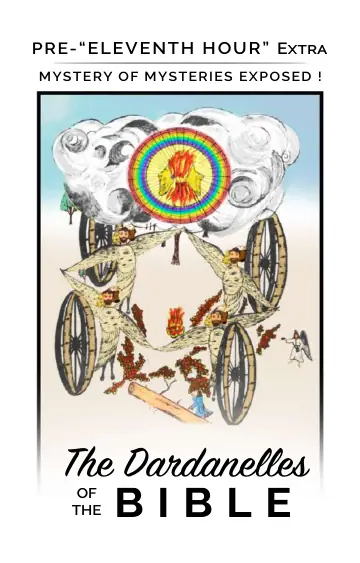
- Mystery of Mysteries Exposed! — The Dardanelles of the Bible
- Author
- Victor T. Houteff
- Publication
- 1933 (copyright editions also dated 1940 and 1941)
- Literature
- Tract No. 1
- Length
- 56 pages
- Central Bible passage
- Ezekiel chapters 1–11, particularly chapters 9 and 10.
I.Introduction: The Central Message of the Tract
The first tract, Pre-“Eleventh Hour” Extra: The Dardanelles of the Bible, presents an interpretation of Ezekiel's vision of the living creatures, wheels, and the throne of God.
The title, The Dardanelles of the Bible, illustrates the connection between heaven and earth. Just as the Dardanelles connects two important bodies of water, the author uses Ezekiel's vision to explain how God communicates with and directs His work on earth.
The central teaching of this tract is that God will perform a special work of purification among His professed people before the worldwide proclamation of the Loud Cry of the Third Angel's Message.
The tract connects several important prophetic subjects:
- The throne of God and the heavenly sanctuary.
- The spiritual condition of the Laodicean Church.
- The purification of the church in Ezekiel 9.
- The sealing of the 144,000.
- The separation of the wicked from among the righteous.
- The preparation of God's people for the Loud Cry.
- The responsibility of God's messengers and watchmen.
Let's examine these teachings one by one.
II.The Major Teachings of Tract No. 1
1Ezekiel's Vision of God's Throne
Main Bible references: Ezekiel 1:4–28; Ezekiel 10:1–22.
Ezekiel saw a remarkable vision beside the river Chebar in the land of the Chaldeans.
The vision included:
- A whirlwind coming from the north.
- A great cloud and fire.
- Four living creatures, identified later as cherubim.
- Four faces: a man, a lion, an ox, and an eagle.
- Four wings and human-like hands.
- Wheels within wheels.
- The appearance of God's glory above the living creatures.
The tract identifies this vision as a manifestation of God's traveling throne, through which the Lord visits the earth to accomplish His purpose.
Supporting references:
2The Four Thrones of God
The tract compares four throne visions found in the Bible.
| Bible passage | Description | Classification in the tract |
|---|---|---|
| Isaiah 6:1–4 | Lord enthroned with seraphim | Traveling throne |
| Revelation 4:2–6 | Throne with sea of glass and seven lamps | Stationary throne |
| Revelation 22:1 | Throne of God and the Lamb with the river of life | Stationary throne |
| Ezekiel 1:4–28 | Throne with cherubim and wheels | Traveling throne |
The author distinguishes the traveling throne in Ezekiel from the vision in Isaiah because of the differences between the cherubim and seraphim.
The tract further connects the heavenly sanctuary throne with the investigative judgment.
Important references:
3The Prophetic Fulfillment of Ezekiel's Vision
Main Bible references: Ezekiel 2:3–7; 3:1–7; 9:1–11.
The tract explains that Ezekiel received a message for the house of Israel, but the prophet did not understand the full meaning of the vision during his lifetime.
The author argues that the prophecy was not exhausted in Ezekiel's historical circumstances because its intended work of marking and slaying had not yet received its complete fulfillment.
The tract therefore applies the vision prophetically to a future work among God's professed people.
It emphasizes that Ezekiel was commissioned to deliver God's message to a rebellious people, regardless of whether they would hear or reject it.
4The Laodicean Church and Its Spiritual Condition
Main Bible references: Revelation 3:14–18; Ezekiel 2:3–7; 3:7.
One of the most important connections in this tract is between Ezekiel's rebellious house and the Laodicean Church.
The tract presents the following comparison:
| Ezekiel's description | Laodicean condition |
|---|---|
| Impudent | Self-confident |
| Hard-hearted | Unwilling to receive correction |
| Rebellious | Resistant to God's message |
| Spiritually unresponsive | Lukewarm |
| Unaware of its true condition | Claims to be rich and in need of nothing |
The tract uses the warning of the True Witness in Revelation 3:14–18 to demonstrate that God's professed people may believe they are spiritually prosperous while remaining in a deplorable condition before Him.
It also quotes Testimonies, Vol. 3, pp. 252–253, concerning the danger of being confident that one is right while actually being wrong.
5The Special Work of Purification of the Church
Main Bible references: Ezekiel 9:1–11; Malachi 3:1–3; Matthew 13:47–50.
This is arguably the central doctrine of the entire tract.
The author connects Ezekiel 9 with the special work of purification among God's people.
In Ezekiel's vision, six men came with slaughter weapons, while another man clothed in linen carried a writer's inkhorn.
The man with the inkhorn was commanded to:
- Go through Jerusalem.
- Place a mark upon the foreheads of those who sigh and cry over the abominations committed in the city.
The other men were commanded to follow and execute judgment, beginning at God's sanctuary.
The tract interprets this as a separation of the wicked from among the righteous within the professed church.
The distinction is important:
- In the purification of the church, the wicked are removed from among the righteous.
- In the subsequent Loud Cry, the righteous are gathered out from among the wicked in Babylon.
Supporting Spirit of Prophecy references:
- The Great Controversy, p. 425 – Special work of purification among God's people.
- Testimonies, Vol. 3, p. 266 – The closing work for the church.
- Prophets and Kings, p. 725 – The purified church entering its final conflict.
6The Sealing of the 144,000 – The First Fruits
Main Bible references: Revelation 7:1–9; Ezekiel 9:4; Revelation 14:1–5.
The tract identifies the marking in Ezekiel 9 with the sealing described in Revelation 7.
It explains that the 144,000 are the first fruits who receive the seal of God during the special purification of the church.
The characteristics emphasized include:
- They sigh and cry over the abominations committed among God's professed people.
- They receive the seal of the living God.
- They stand without fault before God's throne.
- They are prepared for the final gospel work.
- They participate in bringing the everlasting gospel to the nations.
The tract also connects the 144,000 with Isaiah 66:19–20, where those who escape are sent to the nations to declare God's glory.
7The Two Sealing Reports: First Fruits and Second Fruits
This is another important prophetic distinction developed in the tract.
The author compares two reports made by the angel with the writer's inkhorn.
| First report | Second report |
|---|---|
| Ezekiel 9:11 | Early Writings, pp. 279–280 |
| The work of marking in the church is completed. | The work of sealing in the world is completed. |
| Connected with the 144,000. | Connected with the great multitude. |
| The Lord is at the threshold of the house. | Christ is in the heavenly sanctuary before the final declaration. |
| The church purification precedes the final worldwide work. | The final sealing is completed before probation closes. |
The tract interprets these as two distinct phases of the sealing work.
The first fruits are the 144,000, while the second fruits are represented by the great multitude of Revelation 7:9.
8The Escaped Ones Go to All Nations
Main Bible references: Isaiah 66:16, 19–20; Revelation 7:3; Revelation 18:1–4.
After the purification of the church, the tract explains that those who escape become instruments in God's final missionary work.
The 144,000 are presented as the servants of God who help bring the gospel to all nations.
The tract emphasizes two different separations:
- Ezekiel 9 – The wicked are separated from among the righteous in the church.
- Revelation 18 – God's people are called out of Babylon.
This distinction is essential to understanding the tract's prophetic sequence.
The church is first purified, and then the worldwide Loud Cry gathers those who respond to God's message.
9The Danger of Criticism and Faultfinding
Main Bible references: Ezekiel 9:4; Revelation 14:5; Isaiah 58:1.
The tract warns against criticism, faultfinding, and the spirit of opposition toward advancing truth.
It emphasizes that those who sigh and cry are deeply concerned about the spiritual condition of God's people.
Rather than delighting in the mistakes of others, God's people should:
- Recognize sin and its destructive effects.
- Pray earnestly for the church.
- Practice humility.
- Avoid malicious criticism.
- Support the truth through faithful conduct.
- Remain willing to receive correction.
The tract quotes Testimonies, Vol. 5, p. 690, concerning those who criticize everything connected with the unfolding of truth.
10The Pure Message and the Authority of Inspiration
Main Bible references: Ezekiel 2:8–10; 3:1–3; 1 Corinthians 14:37.
Ezekiel was commanded to eat the scroll before delivering the message to Israel.
The tract interprets this experience as representing the reception of God's Word before proclaiming it to others.
The scroll was written within and without and contained lamentations, mourning, and woe.
The author emphasizes that God's messengers must derive their message from Scripture rather than human opinions.
The tract also highlights Ezekiel's experience of being made dumb until God opened his mouth.
This is used to teach that the messenger must speak only what God authorizes.
11The Rejection of Additional Light
Main Bible references: Ezekiel 3:7; Revelation 3:18; Matthew 11:25; 1 Corinthians 1:20.
The tract warns that God's people may reject a message because of prejudice, institutional resistance, or confidence in established religious authorities.
It argues that a person should not reject a message merely because it comes through an unexpected channel.
The preface and final appeal repeatedly emphasize personal investigation.
The tract quotes the following important counsel:
- Education, p. 231.
- Testimonies on Sabbath-School Work, pp. 53, 60, 65–66.
- Testimonies to Ministers, pp. 106–107.
12The Divine Chariot and the Completion of God's Work
Main Bible references: Ezekiel 1:14–21; 10:9–21; Isaiah 66:8; Matthew 24:14.
The tract explains that the four living creatures and their wheels form a divine mechanism under God's direction.
The four faces and the four-way movement demonstrate that the chariot can move in any direction without turning.
The author interprets the chariot as God's instrumentality in directing His work on earth.
The tract quotes Prophets and Kings, p. 536, to emphasize that the complicated events of human history remain under divine control.
It also quotes Testimonies, Vol. 5, p. 754, concerning the divine power guiding the work.
The ultimate purpose is to prepare a purified people to finish the gospel commission.
III.The Purpose of the Message
The tract's discussion on pages 38–41 brings the entire study together.
According to its interpretation, the Lord's purpose in coming with His throne is to:
- Purify His professed people.
- Remove sin and wickedness from among the righteous.
- Place His protection around His purified people.
- Pour out His Spirit upon those who receive the mark.
- Prepare His servants for the final gospel proclamation.
- Bring many nations into the knowledge of God.
- Complete the work of the everlasting gospel.
The tract connects this with Zechariah 2:5, 10–11, where God promises to dwell in the midst of His people and become a wall of fire around Jerusalem.
It also points forward to the glorious scene of the saints ascending in the divine chariot, as described in Early Writings, pp. 287–288.
IV.The Responsibility of God's Watchmen
Main Bible passage: Ezekiel 3:17–21.
The final practical emphasis is the responsibility of those who receive the message.
The tract teaches that those who understand the warning have a responsibility to share it faithfully.
A watchman must:
- Hear God's Word.
- Receive the message personally.
- Warn the wicked.
- Encourage the righteous to remain faithful.
- Avoid fear of opposition.
- Remain humble and obedient.
- Give God the glory for the message.
The tract emphasizes that the responsibility of a watchman is not simply to receive knowledge but to faithfully communicate the warning.
It also appeals to ministers and church members to investigate the message rather than dismiss it without examination.
V.Important Bible and Spirit of Prophecy References
The following references provide a useful reading guide for studying this tract.
| Subject | Bible references | Spirit of Prophecy |
|---|---|---|
| God's throne | Ezek. 1; Dan. 7:9–10 | Early Writings, p. 55 |
| Laodicean condition | Rev. 3:14–18 | Testimonies, Vol. 3, pp. 252–253 |
| Church purification | Ezek. 9 | GC, p. 425 |
| Sealing of the 144,000 | Rev. 7; Ezek. 9:4 | TM, pp. 444–445 |
| Closing work for the church | Ezek. 9:3–11 | Testimonies, Vol. 3, p. 266 |
| Final gospel work | Isa. 66:19–20; Rev. 18:1–4 | PK, p. 725 |
| God's divine direction | Ezek. 1:14–21 | PK, p. 536 |
| Divine power in the work | Ezek. 10 | Testimonies, Vol. 5, p. 754 |
| Faithful watchmen | Ezek. 3:17–21 | Testimonies, Vol. 5, pp. 80–83 |
| Personal investigation | Acts 17:11; John 5:39 | Education, p. 231 |
Abbreviations: GC – The Great Controversy; PK – Prophets and Kings; TM – Testimonies to Ministers.
VI.The Prophetic Sequence Presented in Tract No. 1
The following diagram summarizes the sequence of events as the author presents them.
The Prophetic Sequence
According to the interpretation presented in the tract
- The Laodicean conditionThe church needs spiritual awakening and reformation.Revelation 3:14–18
- The message of warningThe unfolding of Ezekiel's prophetic vision.Ezekiel 1–3
- The purification of the churchThe marking of those who sigh and cry and the separation described in Ezekiel 9.Ezekiel 9:1–11
- The sealing of the 144,000The first fruits prepared for the final gospel work.Revelation 7:1–4
- The Loud CryThe purified church proclaims the message to the world.Revelation 18:1–4
- The great multitudeThe worldwide ingathering, described as the second fruits.Revelation 7:9
- The completion of the gospel workChrist's final victory and the gathering of His redeemed people.Matthew 24:14; Early Writings, pp. 287–288
VII.Practical Lessons for Every Believer
Beyond prophetic interpretation, this tract contains important spiritual lessons.
- Never become satisfied with your present knowledge.Continue searching the Scriptures and growing in the knowledge of God's truth.
- Examine your own spiritual condition.Do not become so concerned with the faults of others that you neglect your own need for repentance.
- Develop the spirit of sighing and crying.Love the church enough to pray for its restoration and to grieve over the sins committed within it.
- Be faithful to the message entrusted to you.Those who receive truth have a responsibility to share it with humility and courage.
- Avoid prejudice and criticism.Do not reject a message simply because it is unfamiliar or comes through an unexpected messenger. Examine its biblical foundation.
- Allow God to purify your character.The objective of the sealing is not merely outward identification but preparation for a holy life and faithful service.
- Depend upon God rather than human strength.The divine chariot illustrates that God's work is under His control and direction.
VIII.Concluding Summary
The Central Message of Tract No. 1
The Pre-“Eleventh Hour” Extra presents Ezekiel's vision as a prophetic revelation of God's special intervention in behalf of His professed people.
Its central theme is the purification of the church, the sealing of the 144,000, and the preparation of a faithful people who will participate in the final proclamation of the everlasting gospel.
The tract calls every believer to investigate the Word of God, overcome spiritual complacency, sigh and cry over the sins of the church, receive the sealing truth, and faithfully fulfill the responsibility of a watchman.
A concluding Bible passage for personal reflection:
The challenge of this first tract is not simply to understand prophetic symbols but to recognize our personal responsibility before God.
We should not merely study the vision of Ezekiel; we should examine our hearts, seek God's righteousness, and prepare to become faithful servants in His work.
IX.Suggested Study Questions
For individual study, family worship, or a Present Truth Bible study group:
- What is the significance of the four living creatures and the wheels in Ezekiel 1?
- Why does the tract distinguish between traveling and stationary thrones?
- What connection does the author make between Ezekiel's rebellious house and the Laodicean Church?
- What is the relationship between Ezekiel 9 and Revelation 7?
- Why does the tract distinguish between the first fruits and the second fruits?
- What is the difference between the purification of the church and the calling of God's people out of Babylon?
- What characteristics should be manifested by those who sigh and cry?
- What is the responsibility of the watchman in Ezekiel 3:17–21?
- Why is personal investigation of Scripture essential?
- How should this message influence our spiritual preparation and missionary responsibilities?
X.Recommended Reading Plan
This 56-page tract can be divided into six study sessions:
| Session | Pages | Study topic |
|---|---|---|
| 1 | 3–10 | Introduction and Ezekiel's vision of God's throne |
| 2 | 11–18 | Prophetic fulfillment, Laodicea, and church purification |
| 3 | 19–27 | Sealing of the 144,000, two fruits, and separation |
| 4 | 28–38 | Pure message, rejection of truth, and divine chariot |
| 5 | 39–47 | Purpose of the message and responsibility of watchmen |
| 6 | 48–53 | Final appeal, personal investigation, and prayer |
Pages 54–56 contain the literature notice and scriptural and topical indexes.